

You’ve invested in paid ads. Your conversion rate is up. Revenue is growing.
Maybe you’ve added trust signals to checkout, launched a checkout upsell, or improved the post-purchase experience with Checkout Plus.
But here’s a question most Shopify merchants never stop to ask: is that revenue actually turning into profit?
The uncomfortable answer is that many stores generate more revenue every month and make less money than they did the year before. Checkout optimization can drive more transactions and higher order values but if the underlying costs are growing faster than revenue, every additional sale moves the business further into the red.
Before scaling what’s working at checkout, it’s worth understanding what your store is actually keeping from each transaction.
The Revenue Illusion
Shopify is very good at showing you revenue. After every order, you see the total. After every week, you see the chart going up. The dashboard feels positive.
What Shopify doesn’t show you is what happens after that revenue is earned.
Consider what gets subtracted from every order:
- Cost of goods sold (COGS) — what the product actually cost you to source or manufacture
- Payment processing fees — typically 2.9% + $0.30 per transaction on Shopify Payments
- Shipping costs — what you actually paid the carrier, not what the customer paid
- Ad spend — the portion of your daily campaign budget that drove this specific order
- Discounts — any codes or automatic promotions applied at checkout
- Returns and refunds — fully or partially refunded orders that reduce revenue but don’t reduce costs
When you subtract all of these from a $100 order, the actual net profit on that order might be $8. Or it might be negative.
Merchants who only look at revenue—or even gross revenue after refunds—are making decisions on incomplete data.
Why Conversion Rate Alone Is a Dangerous Metric
Increasing checkout conversion rate is valuable. Shopify merchants often improve conversion rates through checkout optimizations like trust badges, delivery messaging, social proof, checkout upsells, and post-purchase offers.
But conversion rate only tells you how many people completed a purchase. It says nothing about whether those purchases were profitable.
A store with a 4% conversion rate and a $12 average net profit per order is more profitable than a store with a 5% conversion rate and a $3 average net profit per order.
For example, a merchant might use Checkout Plus to add a checkout upsell that increases average order value from $85 to $95. Revenue increases immediately, which looks like a clear win. But if that upsell has lower margins, higher shipping costs, or a higher return rate, the profitability impact may be much smaller than expected.
The same logic applies to average order value. Increasing AOV through upsells and add-ons—which checkout optimization tools make easier—is genuinely effective at improving profitability. But only if you know the margin on those upsells. An upsell with a thin margin might barely move the needle. An upsell on a high-margin product can dramatically improve per-order profit.
Without knowing margin at the product level, it’s difficult to know which upsells to prioritize.
Why Checkout Optimization Works
Many Shopify merchants immediately look to increase ad spend when they want more revenue. The problem is that acquiring additional traffic is becoming increasingly expensive.
Checkout optimization improves the value of the traffic you’re already paying for.
With Checkout Plus, merchants can:
- Add trust badges and trust signals
- Display shipping and delivery messaging
- Add checkout upsells
- Collect delivery instructions and order notes
- Customize Thank You and Order Status pages
- Display reviews and social proof
- Create post-purchase offers
These improvements can increase conversion rates and average order value without increasing acquisition costs.
That’s the good news.
The challenge is understanding whether those additional orders are actually increasing profit.
The Missing Metric: POAS
Most Shopify merchants track ROAS Return on Ad Spend. It’s a useful signal, but it measures revenue generated per dollar spent on ads, not profit.
A campaign with a 5x ROAS sounds strong. But if the products being sold have a 20% margin after COGS, shipping, and fees, that 5x ROAS might be generating a negative return on the actual marketing investment.
The metric that matters is POAS Profit on Ad Spend. This measures how much net profit each advertising dollar generates after all costs.
Two campaigns can have identical ROAS and completely different profitability depending on which products they sell, what shipping costs are involved, and how often those orders result in returns.
Knowing Your Real Numbers
Understanding profit at the order and product level requires aggregating data from several sources that don’t naturally talk to each other: Shopify for order data, Meta and Google for ad spend, your supplier for COGS, and your carrier for actual shipping costs.
This is where profit analytics tools like ClearProfit become useful. ClearProfit connects directly to your Shopify store and ad platforms Meta, TikTok, Google, Snapchat, and Pinterest and automatically calculates your real net profit per order, per product, and per campaign after every cost is deducted. No spreadsheets, no manual entry.
For merchants investing in checkout optimization, having this visibility answers the next logical question: are these improvements actually increasing net profit, or just revenue?

A Practical Example
Consider a Shopify store with these monthly numbers:
- 2,000 orders per month
- $85 average order value
- $170,000 monthly revenue
- 3.5% checkout conversion rate
After implementing several Checkout Plus features including trust signals, delivery messaging, a checkout upsell, and a post-purchase offer the store improves to:
- 2,400 orders per month
- $95 average order value
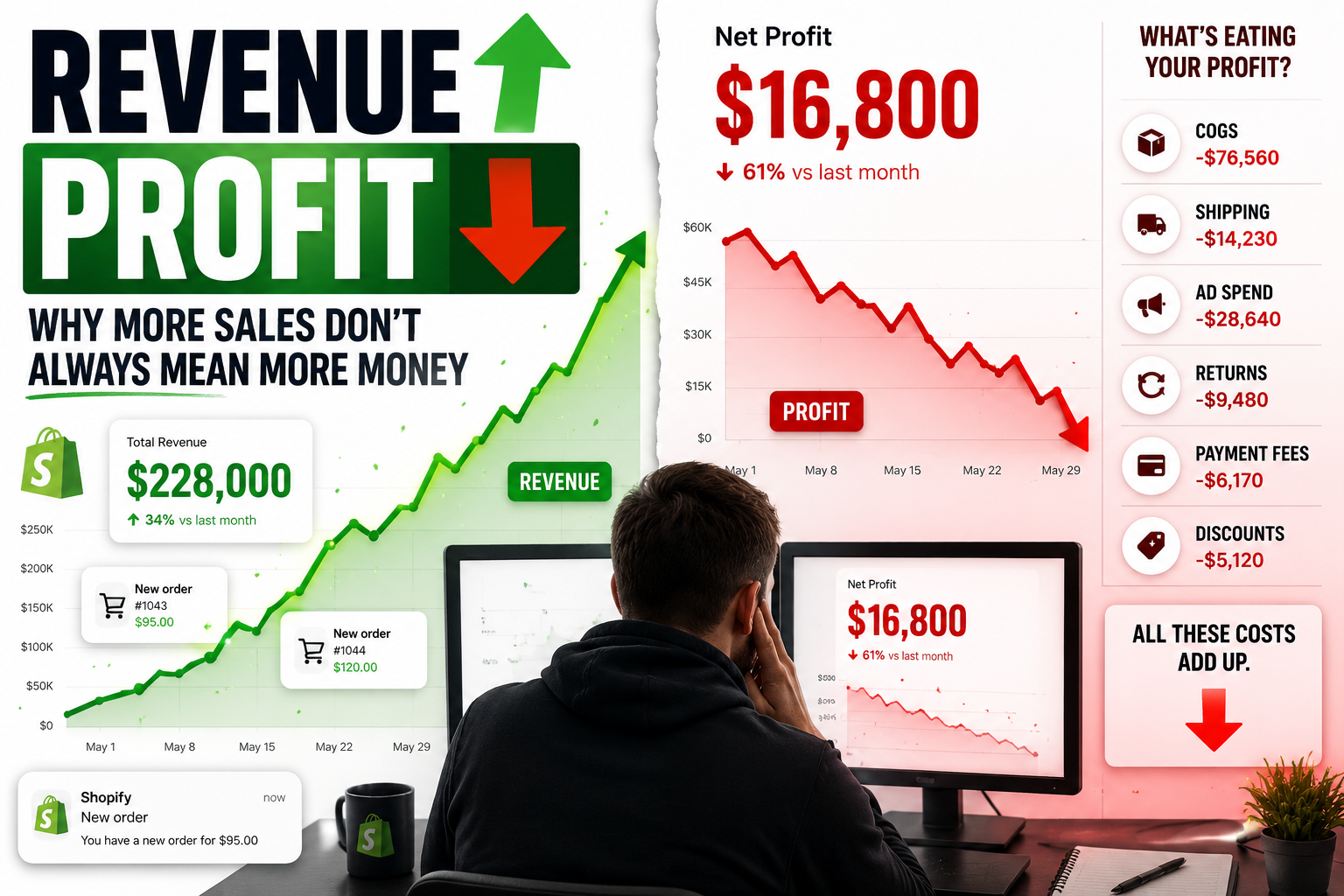
- $228,000 monthly revenue
Revenue is up 34%. The checkout work clearly drove results.
But now consider two versions of this store:
Store A tracks net profit per order and knows that their average product margin is 38%, their ad spend per order is $12, and their shipping cost averages $6. Their net profit per order is approximately $18. At 2,400 orders, that’s $43,200 in monthly net profit.
Store B doesn’t track net profit at the order level. They scaled ad spend alongside the revenue increase, launched a promotion that brought AOV up but margin down, and their shipping costs increased due to a heavier average order. Their actual net profit per order dropped to $7 generating $16,800 in monthly net profit despite the revenue increase.
Same conversion rate improvement. Dramatically different profit outcome.
What Comes After Checkout Optimization
Checkout optimization and profit tracking solve different but complementary problems.
Checkout Plus helps Shopify merchants increase conversion rates, grow average order value, improve customer experience, and generate more revenue from the traffic they already have.
Features like trust signals, checkout upsells, post-purchase offers, review integrations, and customized Thank You pages can have a meaningful impact on revenue without requiring additional advertising spend.
But revenue is only part of the equation.
ClearProfit helps merchants understand whether that additional revenue is actually translating into profit after advertising costs, shipping, fees, discounts, and returns are accounted for.
The most successful Shopify brands don’t focus on revenue alone.
They focus on profitable growth.
By combining checkout optimization with accurate profit analytics, merchants can confidently answer two critical questions:
- How can we generate more revenue from the traffic we already have?
- Which of those revenue gains are actually improving our bottom line?
Checkout Plus helps answer the first question.
ClearProfit helps answer the second.
Together, they give Shopify merchants a complete picture of growth from the moment a customer reaches checkout to the actual profit left in the bank account after every cost is deducted.